

Stakeholder Mapping using Power Interest Grid is a proven and practical technique that helps project managers identify, prioritize, and effectively engage stakeholders throughout the project lifecycle. Projects rarely fail due to poor planning alone; they fail when stakeholder expectations, influence, and interests are not properly understood or managed.
This article explains why stakeholder mapping is important, the challenges involved, the techniques used, and the benefits of stakeholder analysis using the Power-Interest Grid, along with practical insights every project professional should know.
Stakeholders are individuals or groups who can influence, or are impacted by, a project’s outcomes. Stakeholder mapping helps project managers identify who matters most, how much influence they hold, and how interested they are in the project.
Without stakeholder mapping:
Effective stakeholder mapping using Power Interest Grid enables project managers to tailor communication, engagement strategies, and decision-making approaches for different stakeholder groups. This alignment is crucial for managing expectations, minimizing conflicts, and maintaining momentum throughout the project lifecycle.
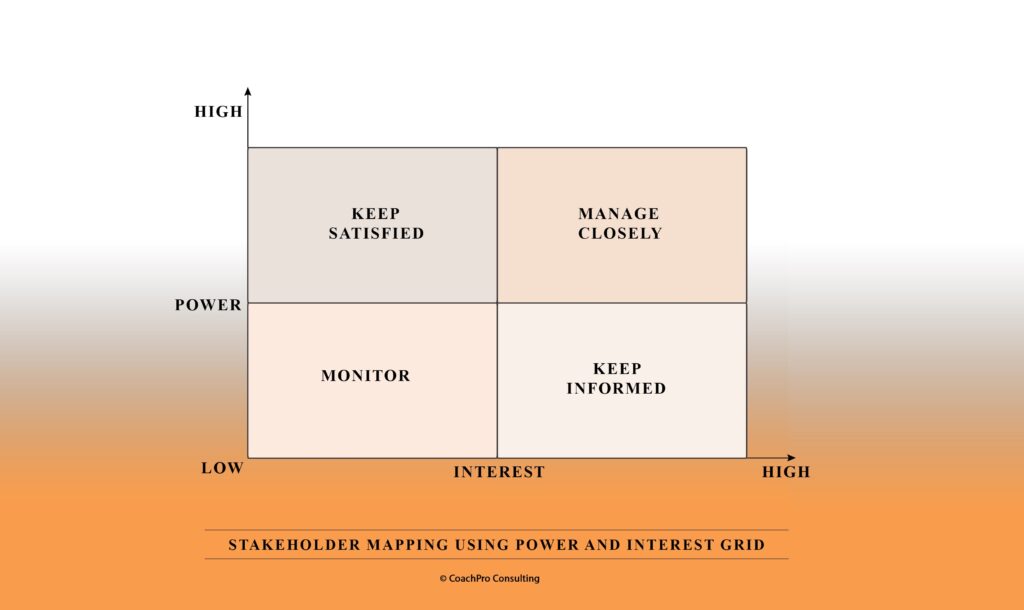
The Power-Interest Grid is a visual stakeholder analysis tool that categorizes stakeholders based on:
The power-interest grid consists of an X-axis (interest) and a Y-axis (power), divided into four quadrants:
Low Power – Low Interest (Monitor): These stakeholders need to be monitored and require minimal communication to avoid overwhelming them. For example, Junior Team Members in a Large Organization. In a large organization, junior team members who are not directly involved in the project and whose roles do not significantly influence the project’s outcomes fall into this category. While they need to be aware of the project’s existence, overwhelming them with detailed updates or frequent communications can be counterproductive.
Example: Junior team members in large organizations who are not directly involved in project outcomes.
Engagement Strategy:
Low Power – High Interest (Keep Informed): Keep these stakeholders informed and ensure their concerns are addressed to gain their support. For example End-Users of a Software Development Project. End-users, such as employees who will use the new software, have a high interest in the project because it affects their daily work. However, they do not have a significant influence over project decisions.
Example: End-users of a software implementation project.
Engagement Strategy:
Keeping them informed increases adoption and reduces resistance during implementation.
High Power – Low Interest (Keep Satisfied): Keep these stakeholders satisfied and should be kept in the loop, even if they aren’t very interested, to prevent potential issues due to their influence. For example, Senior Executives in a Non-Core Business Area. Senior executives who oversee multiple projects but for whom this particular project is not a top priority fall into this category. Their decisions can greatly impact the project, but they may not be deeply interested in the day-to-day details.
Example: Senior executives overseeing multiple initiatives.
Engagement Strategy:
Failure to keep them satisfied can lead to unexpected project roadblocks.
High Power – High Interest (Manage Closely): These stakeholders need to be managed closely. Engage with these stakeholders regularly and manage their expectations carefully, as they are crucial to project success. For example, Project Sponsors. Project sponsors, such as a C-level executive funding the project, or key clients who are the end recipients of the project’s outcomes, have both the power to influence decisions and a vested interest in the project’s success.
Example: Project sponsors, key clients, or funding authorities.
Engagement Strategy:
Their support directly determines project success or failure.
While stakeholder mapping is powerful, it comes with challenges:
Some stakeholders influence projects informally and may not appear in official documentation.
Power and interest levels can change during the project lifecycle, requiring continuous reassessment.
Different stakeholders often have competing priorities, making alignment difficult.
Too much or too little communication can disengage stakeholders.
To overcome these challenges, project managers use multiple techniques:
Combining these techniques improves accuracy and relevance in stakeholder analysis.
Using stakeholder mapping with Power Interest Grid delivers multiple benefits:
It also strengthens leadership credibility and enhances trust between project teams and stakeholders.
Stakeholder Mapping using Power Interest Grid is not a one-time activity, it is a continuous process that evolves with the project. When used correctly, it becomes a powerful leadership tool that helps project managers influence outcomes, build trust, and deliver successful results.
Organizations that invest in strong stakeholder analysis consistently outperform those that rely on assumptions. Mastering this technique is essential for every project professional aiming to deliver value-driven outcomes in today’s complex business environment.
Professionals looking to master stakeholder management can explore CoachPro Consulting’s project management certification programs available through the CoachPro LMS.